
“Is that really rain?”
Raleigh – April 17, 2011
Background: On March 1, SB8 version 8 lifting the cap on charter schools was passed by the Senate and sent over to the House for their approval. After six weeks of wrangling in the House, however, it morphed through amendments and substitutes into a tangled mess that serves no one well.
In this morphed form it passed the House and went back to the Senate for concurrence where it failed unanimously on Thursday, April 14. Now the bill is in conference to be reconciled.
Problems with the House version: On Friday morning after failing concurrence, the NC House released a note (See http://bit.ly/hqisWB ) to “clarify some of the concerns” raised by long standing charter leaders and others (the entire Senate?) intimately involved in charter schools. (See http://www.nccivitas.org/2011/sb-8-time-to-walk-away/ and, less diplomatically, https://bakermitchelljr.com/2011/04/08/clueless-caucus-crushes-charters/ )
The very fact of having to “clarify” the bill should raise some red flags, but let’s deal with the bill and these clarifications.
The Cap
Recall that the Republicans ran on the promise to “eliminate” the 100-school cap, and this was done in the Senate version. The clarification of the House version states, “That cap will be removed.” But it goes on to admit that after removing that cap, the bill demands that a new cap of 50 new schools per year be imposed. So let’s be honest; the bill does not eliminate the cap; it merely raises it each year.
- Please don’t tell us that the cap will be ”removed” by this bill when it is just being replaced by another form of cap.
The note further states that, “We believe that 50 charters are more than would ever be approved in a year due to the application process.”
First, why have an application process that is so cumbersome that it bottlenecks the approvals to less than 50 in a year. And if that is indeed the case, then it is unnecessary to impose any statutory limit – just let the bureaucracy strangle the applicants and create a line at the window.
- Again, please don’t tell us the cap will be “removed” when you then admit that the bureaucratic application process will serve as a new capping mechanism.
Second, if there are more than 50 qualified applicants, the House bill does not give any criteria for ranking the top 50 to receive their charters. The current statute clearly defines a ranking criteria that the applicants shall be graded as to the degree to which they will best further a district’s educational goals. No such basis is available to sort out the winning 50 in the new uncapped capped version. The bill could at least suggest a lottery among the qualified applicants – a method which the Governor would undoubtedly approve.
Finally, the note asserts that charter status awarded directly by the SBE to district schools in the “Restart” model “do not count against the yearly limit” [cap? – supposedly removed!]. I’m glad the House is sure of that, because in the original statute it was deemed necessary to insert a statement that granting charter status to these schools does not count against the cap. These words are removed in the House’s bill. Why? If they were felt necessary before, what does it hurt to leave them in?
- Please don’t tell us that “Restarts” don’t count against the new “limit” when the original drafters clearly thought they did and included language to that effect which you removed.
In summary, we have gone from eliminating the cap to an annual cap of less than 50 per year due to a clot in the application artery. And in the event the clot dissolves, there are no clear criteria to prioritize the applications. And the SBE could possibly use up all the charters for its low-performing district schools. (Wisconsin recently authorized 49 charters in Detroit alone.)
Governance
The Senate bill SB8 version 8 that went into the House clearly left more control of charters in the hands of an independent commission. The commission was not required to seek approval on any measure from the SBE. Only by a 2/3 vote could the SBE veto a commission action. (Even this degree of control is still a major concern to most charter leaders: https://bakermitchelljr.com/2011/04/07/170-elected-reps-bow-to-11-appointees/ )
In contrast, the House bill surrenders completely and allows the commission only the power to “recommend” measures to the SBE. The SBE must approve, by a positive vote, anything and everything the commission wants to do.
But the clarification mystifies one by claiming, “Those who favor less interference with charters by the State Board of Education should welcome this new proposal.” Really?
- Please don’t tell us that your system of submitting “recommendations” requiring “approvals” constitutes “less interference” than unilateral actions that must be vetoed.
To perhaps “clarify” this point, the clarification states that in the bill SBE approval cannot be unreasonably withheld nor can disapproval be arbitrary or capricious.
Over the last decade, I have personally witnessed a number of decisions handed down by the SBE. Despite being an unaccountable body of appointees who prohibit public comment at their meetings, I have never seen an arbitrary or capricious ruling – only decisions earmarked by abysmally terrible judgment and/or total ignorance of the facts.
- Please don’t tell us that your prohibitions of arbitrariness or capriciousness will result in “less interference” when bad judgment, ignorance, and anti-charter bias are the real concerns.
Accountability
Nowhere is the House bill more misguided, more confusing, and misinformed than with the accountability topic. Whomever is furnishing analysis or advice to the House leaders has done a terrible disservice to them and to the entire education community. But this ‘accountability’ section wins the prize for confused, misinformed, ambiguous language.
The current law, passed in 1996, requires that the academic goals be stated in the application and made a part of the charter contract. Termination or non-renewal for academic reasons is based on the school’s failure to meet its promised goals as set forth in the application and mutually agreed upon between the parties.
For example, if the charter founders of an inner-city school promised to raise local performance composites from 35% to 55% in 5 years and that goal was accomplished, then they would be renewed. If it was to be a gifted and talented charter and the founders promised 90% performance and they only achieved 85%, then they might be subject to termination or nonrenewal. Termination and nonrenewal depended upon non-fulfillment of the contract by the school.
So under current law, at the awarding of the charter, the charter group and the state mutually agree upon the academic performance goals and if the charter fails to reach these mutually agreed-upon goals, then it is subject to termination. (§ 115C‑238.29G)
In December of 2009, the SBE tried to supersede this law by adopting a policy whereby they could shut down any school that failed to make 60% composite performance on the state’s EOG tests for two out of any three years. This policy has yet to be codified after nearly a year and a half. See TCS-U-001 whose heading declares: THIS POLICY HAS BEEN ADOPTED BY THE NC STATE BOARD OF EDUCATION, BUT IS STILL PENDING CODIFICATION IN THE NC ADMINISTRATIVE CODE. ALL CODIFIED RULES MAY BE ACCESSED BY GOING TO THE OAH WEBSITE.
The clarification note characterizes the new House bill as being “more lenient” than this still-uncodified SBE policy. Because the bill implies that the three-year 60% threshold is an average? But what about the current law? Is a one-size-fits-all 60% more lenient than the current law’s breach of contract?
The note also attempts to “clarify” that the bill’s phrase “no growth in student performance” – an undefined phrase in state statistical jargon – equates to the well-defined phrase “not meeting or exceeding expected growth.” Many would argue that these two phrases have different meanings and would need to spend some money in obtaining a judicial opinion to sort out this issue.
- Please don’t tell us that a vague undefined growth criteria and a 60% threshold are “more lenient” and should usurp the criteria that were mutually agreed upon by the parties at contract signing as specified by current law.
The clarification further claims that this “lenient” 60% is important: “This is important because many charters specifically target “at-risk” students.” Many charters do specifically target at-risk students. The note also properly praises Rep. Marcus Brandon as being the lone Democrat to support this bill. A check of DPI ABC results for Mr. Brandon’s district reveals that last year 19 of 46 elementary schools had performance composites of less than 60%. Yes, they can use help; but who would invest years of effort and untold funds only to face possible termination in spite of performing above the surrounding area schools. In attempting to defend the needs of his district, Mr. Brandon’s courage and good intentions are without question, but this bill will not achieve his desired result. The most prudent place to put a charter under the House bill is in a high income area that already has high academic achievement.
- Please don’t tell us how important this accountability section is for at-risk students when in fact it can force closure of schools that are outperforming the nearby traditional schools and when it chills opening new schools in high-risk areas.
Funding
Hooray! The clarification gets it correct: historically, a student who transfers to a charter school leaves behind 20% to 30% of the funds that his traditional school received. He brings only 70% to 80% of his original funding with him to his charter school.
However, this bill gets it wrong and under legislation passed last year, this gap can widen because counties can remove even more funds from being shared with charters by hiding money from charters in new “Special Programs.” The Senate bill fixed this loophole and placed charters on a more equal footing. The House bill reopens the loophole and returns charter children to second-class status.
The clarification puzzlingly attempts to comfort charter proponents by stating “the funding mechanism established for [charters] ensures that traditional public schools get more resources per student as and when more charters are established [and charter will, therefore, get less].” [emphasis added]
- Please don’t tell us that we should not have concerns when the House bill has the net effect of actually widening the funding gap between traditional and charter schools.
Other “Advantages”
The clarification asks us to consider a chief advantage to the House bill “is that for the first time counties would be allowed, at their option, to provide capital money for charters.”
Please don’t tell us that counties now will be flooding charters with capital funds when these counties are fighting tooth and nail to resist even allocating the amounts that are statutorily required.
Besides, this was one area that was left intact from the Senate version.
In summary, please don’t whiz on my boots and tell me it’s raining.
Regardless, the House is owed a debt of gratitude for their efforts on behalf of the education system of our state. Majority Leader Stam has a number of other bills that will prove truly very beneficial. But as mentioned earlier, they have been badly advised and been given some very defective data on this charter bill.
Let’s hope the House seeks better counsel in the upcoming conference committee. But bring a towel to dry your boots – just in case it “rains.”
Clueless Caucus Crushes Charters
Raleigh – 4/7/11 In a breathtaking fit of silly nonsense worthy of Monty Python, the NC Republican house caucus passed a committee substitute charter bill that bore little resemblance to the Senate bill that was sent to it a week or so ago.
- The cap would be paradoxically eliminated by imposing a 50 school per year cap!
- New charters for at-risk and disabled children are encouraged to apply, but then will be terminated or not renewed if in a three-year period the children do not pass at least 60% of the state’s tests. (State-wide passing for all 3rd grade reading was 57.8% in 2009-10. For Black students it was 39.4%. )
- Although they do not receive capital funds to buy buses or build cafeterias, new charter schools are required to provide transport and food for children of families with incomes less than 185% of the poverty level – $41,348 for a family of 4, about the median income for this age group in many areas. Traditional district schools do not have such an equivalent requirement.
- Charter schools, conceived as independent and free of most policies and regulations, would be totally dependent upon the State Board for all application approvals and actions, and the State Board can impose whatever policies and regulations it wishes.
- While non-profit groups are competing among themselves for the uncapped cap of 50 charters, the State Board can directly award charters to districts requesting “Restart” status under Race To The Top. These district charters count against the capless cap of 50.
- No ranking or prioritization method is given for applications in the event there are more complete applications than there are charters remaining in a year. Perhaps a lottery was intended?
To sum up this brilliant piece of legislative genius, charter schools will be less independent with less money but with more mandates while having to beat the state averages in academic performance or face shutdown. Lessors and mortgage companies will undoubtedly mob charter schools with great deals as they seek to share in this smorgasbord of statutory stupidity.
If the Senate concurs, Perdue can sign it and claim to the NEA and other education groups that charters are under her control through the SBE and not to worry as they will be suitably brought to heel. Charters will wither, and she can blame the Republicans.
If the Senate does not concur and it dies in conference, a Democrat can offer a cap-lifter like Senator Stevens’ original one-page SB8. The SBE stays in control, and the Republicans will have to pass it. Perdue will sign it and take credit with the Dems for the popular notion of lifting the cap. Charters stay under the heel of the SBE.
Only if the Senate stands firm on its version 8 that it sent to the house, can charter proponents take a breath. Perdue can veto it at her own peril, and then a real charter bill can be rolled out by a Republican governor in 2013.
http://www.nccivitas.org/2011/sb-8-time-to-walk-away
http://www.ncpublicschools.org/docs/accountability/reports/green/greenbook0910.pdf
170 Elected Reps Bow to 11 Appointees
Some legislators wanted to enact a law that would make charter schools independent of the State Board of Education (SBE). After all, that was the reason for charter schools in the first place…North Carolina’s K-12 education system under the SBE has been a dismal failure despite heroic efforts by many teachers and administrators.
According to government data, NC ranks 46th in graduation rate, 3rd in expulsions, the instruction techniques taught in the state’s ed schools are failing our miniority and low-income students, and our teacher preparation is graded a “D” by the National Council of Teacher Quality. All overseen by the SBE.
But when the legislators wanted to allow charters to operate without answering to the SBE and its failed policies, the SBE threatened a lawsuit on constitutional grounds. They want to maintain their strangle hold on charters, and their suit was to be based on Article 9 Section 5 which states:
Sec. 5. Powers and duties of Board.
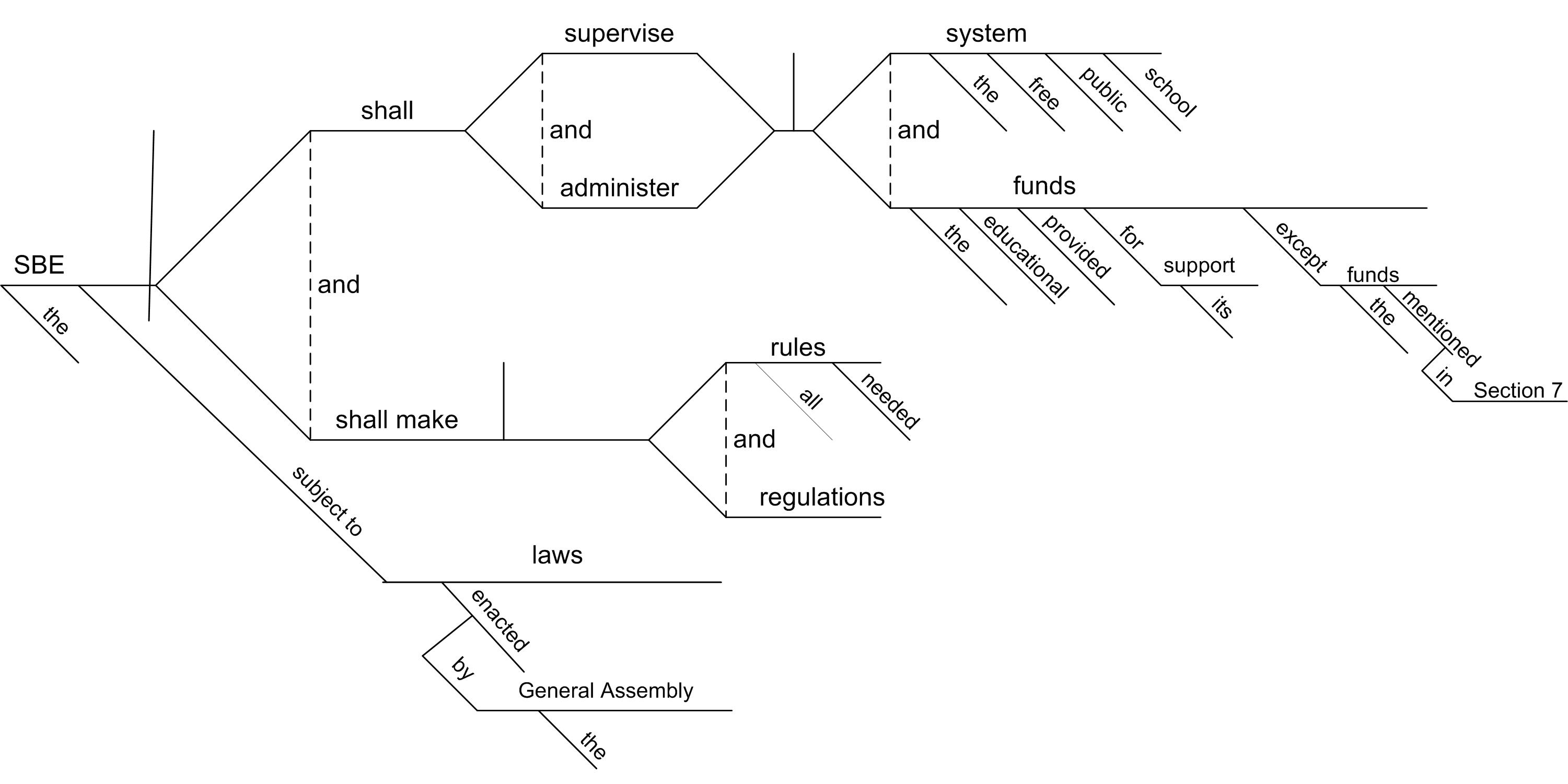
The State Board of Education shall supervise and administer the free public school system and the educational funds provided for its support, except the funds mentioned in Section 7 of this Article, and shall make all needed rules and regulations in relation thereto, subject to laws enacted by the General Assembly.
The mighty North Carolina House and Senate – 170 elected representives – demured without even a whimper to the 11 appointed members of the State Board of Education (SBE). The 170 have skipped out on their duty to the people under the mumbled threat of a legal challenge to their proposed law by the 11 appointees who say that Section 5 requires them to “supervise and administer” everything, regardless of the law.
The General Assembly of 170 elected representatives is conceding its power without an argument to the 11 appointees. The GA says that the ending phrase of Sec. 5 after the comma may be construed by a judge to apply only to the last part of the predicate and not to the subject and sentence as a whole. And, my goodness, we wouldn’t want any disagreements in Raleigh, would we! Can’t we all just get along?
One wonders why the GA bothered to pass the 350 pages of GS 115C if its 170 elected members concede that it is powerless to stop the jugganaut of 11 appointees at the mere hint of a concocted constitutional challenge, Why does the SBE willingly supervise and administer subject to these laws enacted by the GA but threaten suit in the case of another proposed enactment.
http://www.ncleg.net/gascripts/statutes/StatutesTOC.pl?Chapter=0115C
Our education system impacts 1,500,000 children and spends over half our state’s revenue – $11 billion or so. As mentioned, it ranks 46th in the nation in high-school graduation rates and 3rd in expulsions and suspensions. Over half our minority males never graduate from high school and 25,000 children drop out of school every year.
Who utmately controls this currently non-functioning behemoth? The SBE or the GA? The answer to this question is important, and we should not be skipping out on a final resolution to the issue through fear of what a judge might rule.
But a layman’s analysis could be interesting…
YT is not a judge. YT was not even an English major. He are a injunear and messes with compooters; but he did have some of the meanest high-school English teachers on the planet 55 years ago. References to several (more recent) textbooks reveal the following.
Examples:
1a. John shoveled the walk and made a snowman accompanied by his son. [restrictive phrase modifying last verb – no comma ] Means that son only helped with the snowman.
2a. John shoveled the walk and made a snowman, accompanied by his son. [ S V, P. ] Means that son did both.
2b. John, accompanied by his son, shoveled the walk and made a snowman. [S, P, V. ]
Means that son did both.
2c. Accompanied by his son, John shoveled the walk and made a snowman. [P, S V. ] Means that son did both.
1a. The directors must oversee the company and devise policies subject to current market conditions. [restrictive phrase modifying last verb – no comma] Means that only the devised policies must be subject to the market conditions.
2a. The directors must oversee the company and devise policies, subject to current market conditions. [ S V, P. ] Means that directors must observe the market in both overseeing and in policy making.
2b. The directors, subject to current market conditions, must oversee the company and devise policies. [S, P, V. ] ditto
2c. Subject to current market conditions, the directors must oversee the company and devise policies. [P, S V. ] ditto
Decide for yourself. And maybe a judge would disagree, but we at least should have the opportunity to find out if the SBE is subject to the GA.
And here’s another example for all you donkeys…
_________________________________________________
http://www.ncga.state.nc.us/Legislation/constitution/article9.html
North Carolina Constitution of 1971
ARTICLE IX
EDUCATION
Section 1. Education encouraged.
Religion, morality, and knowledge being necessary to good government and the happiness of mankind, schools, libraries, and the means of education shall forever be encouraged. [From the Northwest Ordinance of 1787. YT]
…
Sec. 4. State Board of Education.
(1) Board. The State Board of Education shall consist of the Lieutenant Governor, the Treasurer, and eleven members appointed by the Governor … Appointments shall be for overlapping terms of eight years.
…
Sec. 5. Powers and duties of Board.
The State Board of Education shall supervise and administer the free public school system and the educational funds provided for its support, except the funds mentioned in Section 7 of this Article, and shall make all needed rules and regulations in relation thereto, subject to laws enacted by the General Assembly.
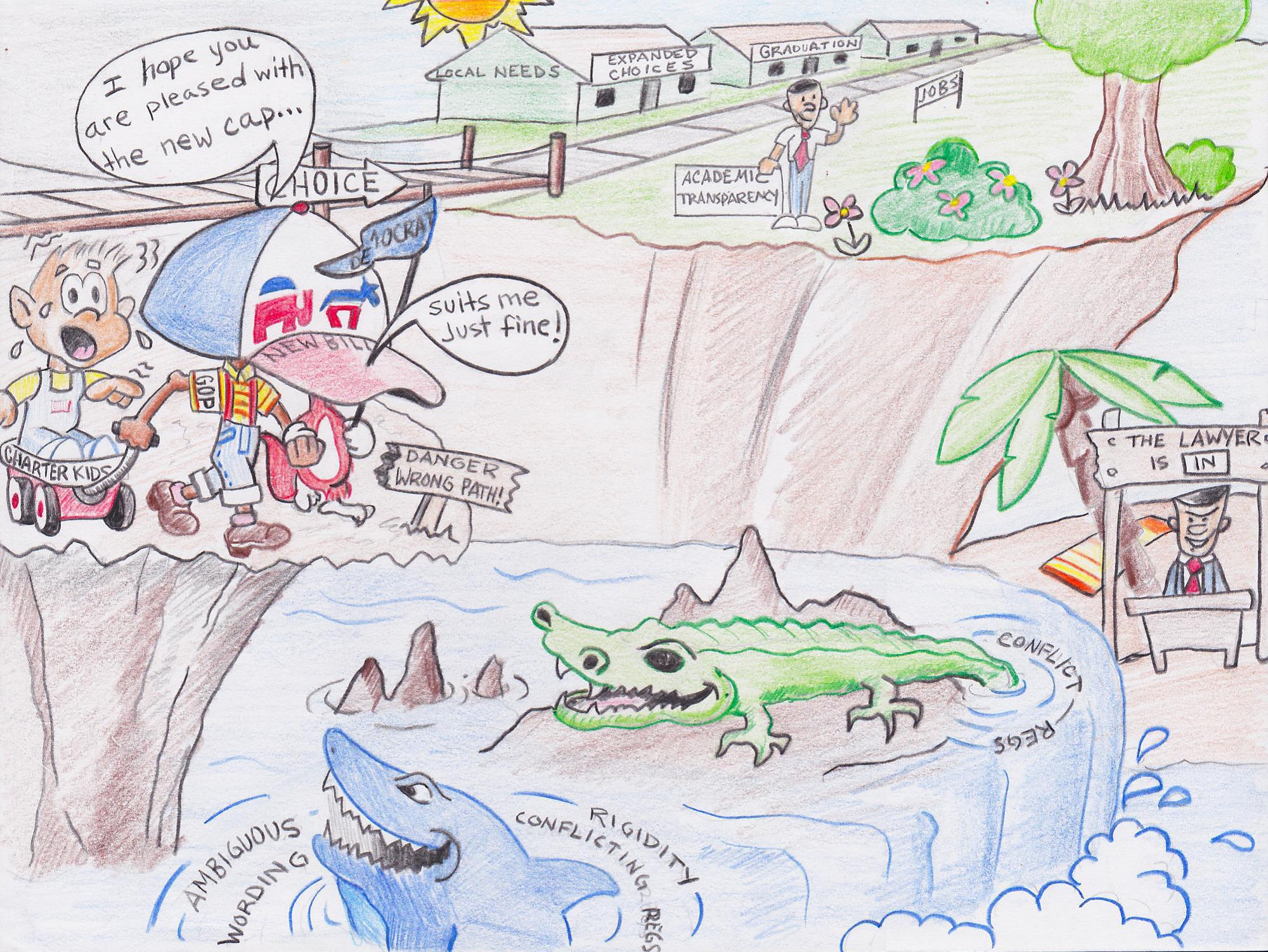
New Charter Bill Chokes Creativity. Skips Risk?
The original 1-page Senate Bill 8 to eliminate the cap on charter has morphed through about 11 revisions into a 20+ page substitute bill submitted to the house finance committee on 4/6/2011. It is a disaster for aspiring applicants, caring communities, and prayful parents.
- First, the cap is not eliminated. It is merely raised to 50 each year.
- If more than 50 qualify, there is no specified priority criteria with which to rank the applicants. Another lottery? Pin the tail on the donkey? Spin the bottle?
- The bill forces an eventual termination or non-renewal for any charter whose performance composite is under 60% in any three years (even start-up) regardless of approved academic goals in the original application. (Intercity schools may be in the 25-35% range, so a 50% goal would be to double the local performance. But less than 60% gets a charter shut down. Facility lessors and lenders…take heed.) So who is going to risk opening a charter in an at-risk area?
- The new “Commission” – quasi-independent of the SBE under ten prior versions – is now ultimately powerless. In this new bill it can only RECOMMEND to the SBE, which must approve everything it does. What caliber of individual wants to just carry the SBE’s water and volunteer to catch their spears?
- It does not equal out the local funding to charters – it makes charter kids second-class students.
- SBE can grant charters directly to LEA “Restart” schools without going through the Commission and yet these count against the new cap of 50/year.
- It forces new charters to provide meals and transportation to all kids from families with annual income less than 185% of the federal poverty level ($41,000 for family of 4; about the median income at that age bracket) with no funds to do so.
So a new charter will face the reduced funding, the 60% closure rule, and the mandated but unfunded food/transportation for kids in families under the median income.
Guess where most new charter schools will be going! In middle- and upper-class, wealthy neighborhods with high-achieving kids. Non-secular private schools will try and figure out a way to convert to charter schools so their parents can avoid tuition.
Guess how much creativity and innovation will be risked when the applicant is staring at the 60% closure rule!
Way to go, House. March right off the cliff. Congratulations.
Holder Hosts Commie Quote, Foregoes Flag
Although this happened back in mid-2010, I just heard about it. From a recently received email….
U.S. Department of Justice ditches the red, white, and blue stars and stripes.
Obama’s Eric Holder changed the U.S. Department of Justice web site.
Gone are the colorful red, white, and blue U.S. Flag decorations on the page,
Replaced by stark black and white. 
And at the top of the page, is a rather interesting quote:
“The common law is the will of mankind, issuing from the life of the people.”
The quote is from C. Wilfred Jenks, who in the 1930’s was a leading proponent of the “international law” movement, which had as its goal to impose a global common law and which backed ‘global workers’ rights.’
Call it Marxism, call it Progressivism, call it Socialism — under any of those names, it definitely makes the DOJ look corrupt in their new website with Marxist accessories to match.
See for yourself: http://www.justice.gov/
How very interesting that ‘they’ couldn’t find a nice quote from one of our Founders. People, we have lost our Republic. This is an example of the slow, methodical misuse of power our current government is doing as they lead us to socialism, and destroying our republic as we have known it.
…Just in case you had not noticed.
NCCAT: Nice but Necessary?
For 2010-2011, NCCAT is costing nearly $7,000,000 for its 95 employees and to operate its two resorts. The New Bern resort accomodates about 23 people and the mountain resort holds about 45.
“NCCAT holds programming in two of North Carolina’s most beautiful locations, providing inspiring instruction from the mountains to the sea.”
http://www.nccat.org/s/1099/start.aspx

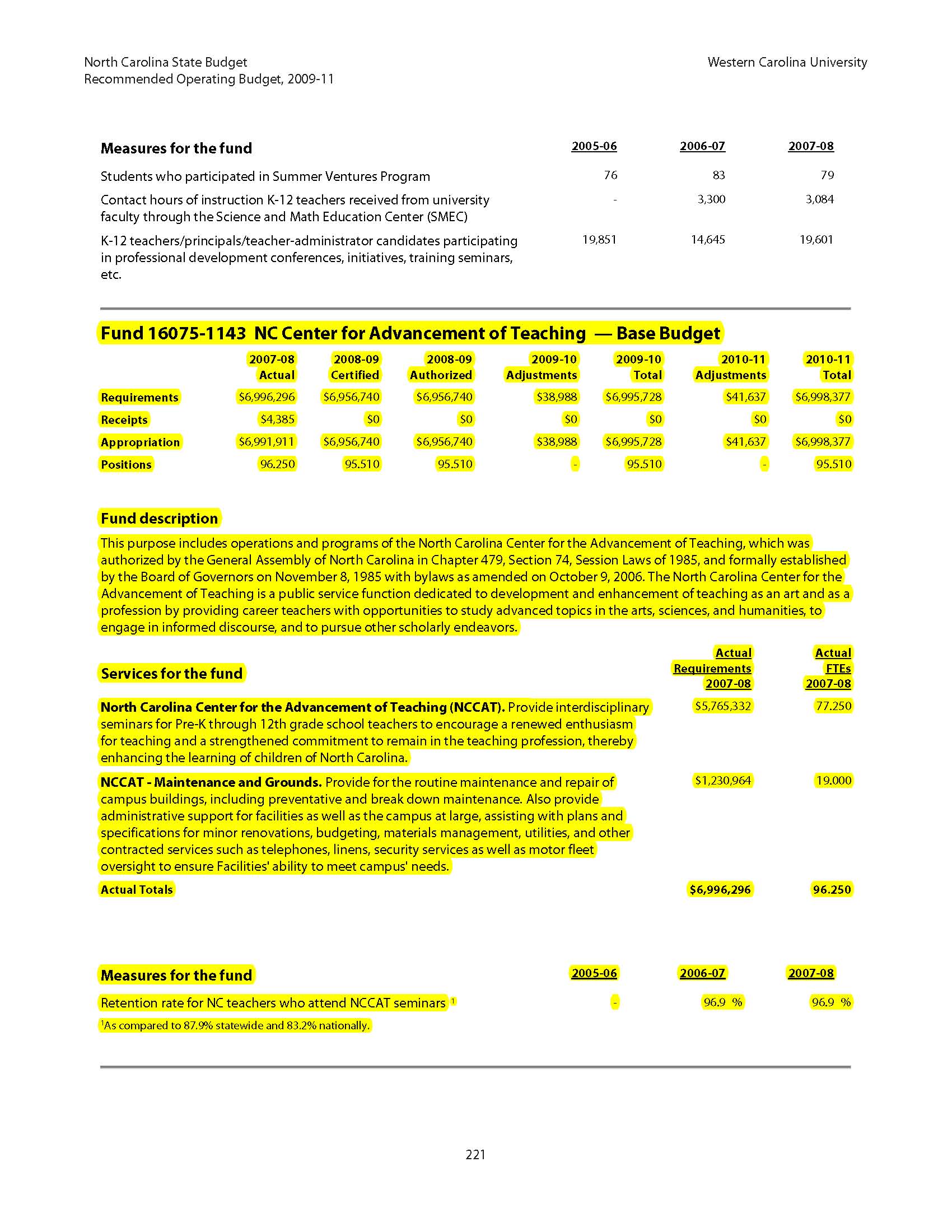
Inspiring 4-day seminars such as:
Oral History: Capturing North Carolina’s Diverse Heritage
The Power of Words
Reading and Writing by the Sea
can be found at http://www.nccat.org/s/1099/index.aspx?sid=1099&gid=1&pgid=288
We have over 100,000 teachers in NC, but these facilities can accomodate only a few thousand each year for their 4-day and weekend seminars.
For $7M a year, we can pay for about 200 full-time classroom teachers serving nearly 4,000 children.
Is NCCAT the best use of taxpayer money?