
The Great Pedagogical Debate: Behaviorism vs. Constructivism
Background
A recent paper (1) published by The John William Pope Center for Higher Education Policy discusses the conflict between the educational objectives desired by the general public and the different objectives implemented by the state’s schools of education which are training our teachers. (See: “UNC Education Schools: Helping or Hindering Potential Teachers” by Dr. G. K. Cunningham)
Dr. Cunningham, the author of three textbooks on educational assessments and goals, thoroughly surveys the conceptual frameworks of the state’s nine major schools of education. In every case, he finds explicit adherence to a framework called “progressive/constructivist,” the principles of which diverge greatly from the public’s perception of what education should be all about. He finds that the state’s higher education establishment for teachers is totally dominated by adherents to this constructivist ideology. There is almost no inclusion or acknowledgement of the alternative set of principles known as “behaviorism” that inform state law.
Purpose of this Paper
Most of us are familiar with the foundations that lead to competing ideologies in various institutions: in economics (Adam Smith’s capitalism vs. Karl Marx’s communism) and religion ( Christianity vs. Islam) for example. Few lay persons are aware, however, of the foundations that drive the competing ideologies in education.
This brief paper attempts to summarize the origins and salient features of these two contrasting approaches to education—behaviorism and constructivism. In so doing, it is hoped that the lay reader can gain a greater understanding of the reasoning behind each approach and be better able to judge the motives and goals of the adherents of each belief.
Ideology in Education: The twenty-first century dawns with a struggle that began taking place on the pedagogical turf of education in the mid-1900’s. (Pedagogy: from pedo + agogy, literally “child” + “leader”)
The ideological struggle between two teaching methods that is taking place cannot be understood without referencing the work of the founding fathers of the two opposing practices:
for constructivism there is the early work of John Dewey but mainly of Swiss psychologist Jean Piaget (Pee-uh-zhay) and his book, “Language and Thought of the Child” written in 1923 and revised in 1932 and again in 1959. One may trace the origins of constructivism further back to Rousseau’s “Emil” and then Dewey’s “My Pedagogic Creed.”
for behaviorism there is the empirical research of Watson and Harvard psychologist B. F. Skinner, “The Behavior of Organisms” (1938) and “Science and Human Behavior” (1953) along with Robert Mager, and others.
Skinner’s 1953 book “Science and Human Behavior” lent solid experimental backing to the more traditional methods of education that had been practiced for thousands of years until their overthrow by Dewey. But Dewey’s die had been firmly cast and constructivism continued to gain momentum until it now completely dominates education in the United States. Like the failed Soviet economy, however, the evident failings of constructivist ideology are prompting traditionalists, buttressed by the proven findings of behaviorism, to begin striving for more control in the decision-making and policy setting of our educational institutions.
From schools of education to legal requirements, from curriculum publishers to departments of instruction and their government-run schools, constructivism has evolved since the 1940’s to become the dominant ideology pervading education. A feature of constructivism that makes it popular in some circles is that constructivism places the responsibility for learning with the learner and not with the teacher. In sharp contrast, behaviorism, supporting traditional methods places the responsibility for learning squarely on the shoulders of the teacher.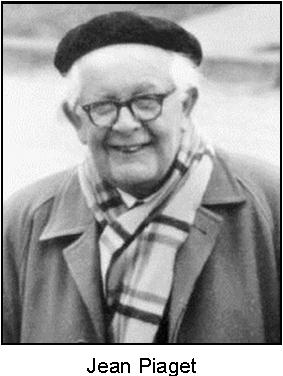
Constructivism is based on a set of assumptions about what goes on inside the learner’s head. Piaget’s constructivism assumes that genetically controlled brain development governs an assumed time-table of when a child is capable of learning. This idea asserts that our brain constructs its own meanings from the social environment when it is ready according to our genetic abilities and that teachers can have only a minimal effect on learning. Fortunately or unfortunately for constructivists none of these assumptions can be, or have been, proven. They can only be inferred to be correct. We cannot pry a subject’s skull open to see what’s going on inside. The same can be said for the psycho-analytical psychologists and their theories about the effects of our past as being abused as children, spoiled as children, ignored as children, or whatever, on the motives governing our present or future actions (and thoughts).
Behaviorism eschews all discussion about what goes on inside the head because we cannot directly measure or observe it. Likewise, the genetic issue is immaterial to the behaviorist. The behaviorist focuses on:
-the present environment of a subject (antecedent conditions = A) and
-what behavior is exhibited (behavior = B) in that environment and
-what consequences follow (consequences = C). 
All factors are observable and subject to experimental verification or refutation. The A-B-C sequences can be experimentally observed with differing antecedent conditions, A, and differing consequences, C, that are under control of the experimenter. Thus, one may answer a question such as, “In a given situation, A, what types of consequences, C, are more effective for producing a desired behavior, B?”
Implications
The implications for developing teaching methodologies based on the two diverging ideas of constructivism or behaviorism are immense.
Constructivists: Constructivists champion practices that emphasize learning through natural peer group social interactions. These practices include such concepts as “brain-based learning,” multi-sensory learning styles, discovery learning, inquiry methods, whole language reading, balanced literacy, authentic learning environments, and many more.
Constructivists may also argue that external rewards such as “smiley faces” on homework or praises such as “Good work, Johnny!” are damaging to the goal of having the student become intrinsically motivated to learn for the sheer rewards inherent in the learning, itself. (See “Punished by Rewards” by Alfie Kohn.)
Behaviorists: Behaviorists point to decades of data from highly controlled studies of matched class rooms that show superior performance when rewards – positive reinforcers – are liberally given for good work. (Behaviorists also like to ask Mr. Kohn if he would have written his book for free without accepting any payment or royalties and why he commands such a high speaking fee.)
Behaviorists point to the proven successes of direct instructional methods and positive reinforcement for motivation that occur with properly trained instructional personnel using carefully sequenced curricula.
Whose fault is failure?
From his childhood, Piaget admitted his disdain for teachers and so tried to undercut their role in the learning process. In so doing, he offered them the perfect excuse for the student’s failure. Unionists and other educational apologists can cling to Piaget and, with the possible exception of falsely blaming societal ills such as poverty and family breakdown, maintain that everyone is blameless in this genetically determined process of the learner having to construct his own learning at a developmentally appropriate rate.
Former Secretary of Education Rod Paige’s book The War Against Hope: How Teachers’ Unions Hurt Children, Hinder Teachers, and Endanger Public Education rails against these apologists but does not identify the theoretical basis for their argued positions.
Constructivists were greatly reinforced by the availability in 1962 of an English translation of the Russian psychologist Lev Vygotsky’s 1934 book “Thought and Language.” As summarized in Susan Path’s recent book “Parallel Paths to Constructivism, Jean Piaget and Lev Vygotsky”, 2004, Path seems to buttress the argument that Vygotsky offers confirming evidence of Piaget’s constructivism.
Even a casual perusal of “Thought and Language” finds, however, a careful attempt to bring order to the divisive field of psychology. Vygotsky tries to first create a taxonomy for the field and includes citations of Piaget (which many may have been mistaken as his confirmation) but he then directly refutes these ideas by saying that “we have developed our own theoretical position in exactly an opposite direction.” Vygotsky goes on to summarize by saying, “Piaget’s view [that the child is impervious to experience – teaching] may hold for the particular group of children he studied, but it is not of universal significance.”
Thus while many seek to use Vygotsky as verification of Piaget, they should heed Vygotsky’s own observation that, “Studying child thought apart from the influence of instruction, as Piaget did, excludes a very important source of change and bars the researcher from posing the question of the interaction of development and instruction to each age level.”
In spite of Vygotsky’s own denial, we now find schools of education citing Dewey, Piaget, and Vygotsky as the unassailable and infallible founding fathers of their new constructivist pedagogy, with the data-driven empirical findings of Skinner being dismissed as mere “rat science.”
North Carolina’s children are woefully deficient in reading comprehension according to numerous tests—both state normed and nationally normed. Small wonder since their education school professors display a similar deficiency by continuing to misread hard data from the research.
The Roger Bacon Academy is a highly successful North Carolina based educational management organization that focuses on behavioral methods in the K-8 classroom. It manages two rural Title I charter schools which are the highest scoring schools in their counties: Columbus Charter School and Charter Day School. Applications for employment are always welcome.
1. www.johnlocke.org/acrobat/pope_articles/cunninghameducationschools.pdf
**HB 823 ** GOOD JOB, REPRESENTATIVES!
Dear NC Representatives,
Congratulations on introducing HB 823 to amend the constitution and put the future of our children in the hands of a Superintendent elected by the people of North Carolina. Thank you.
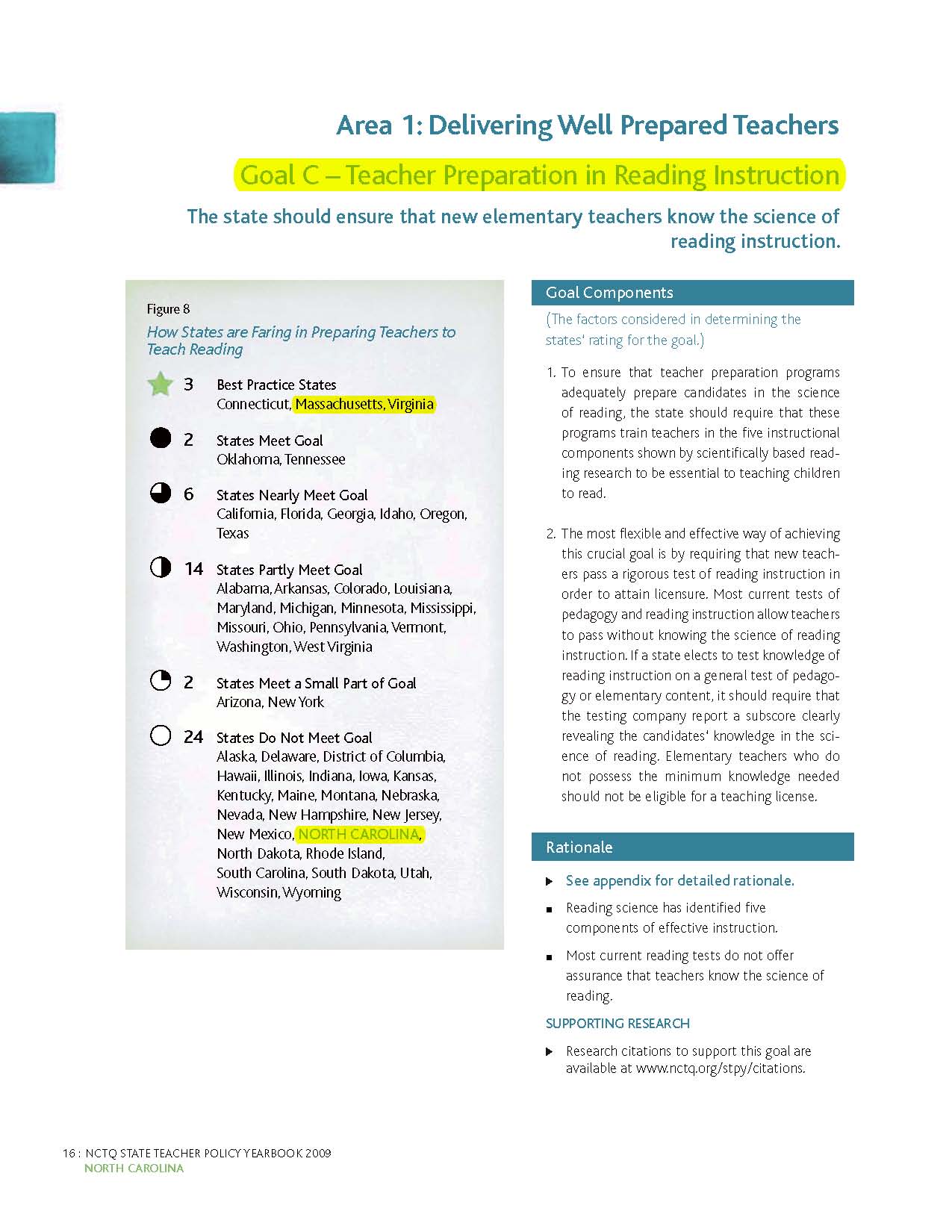
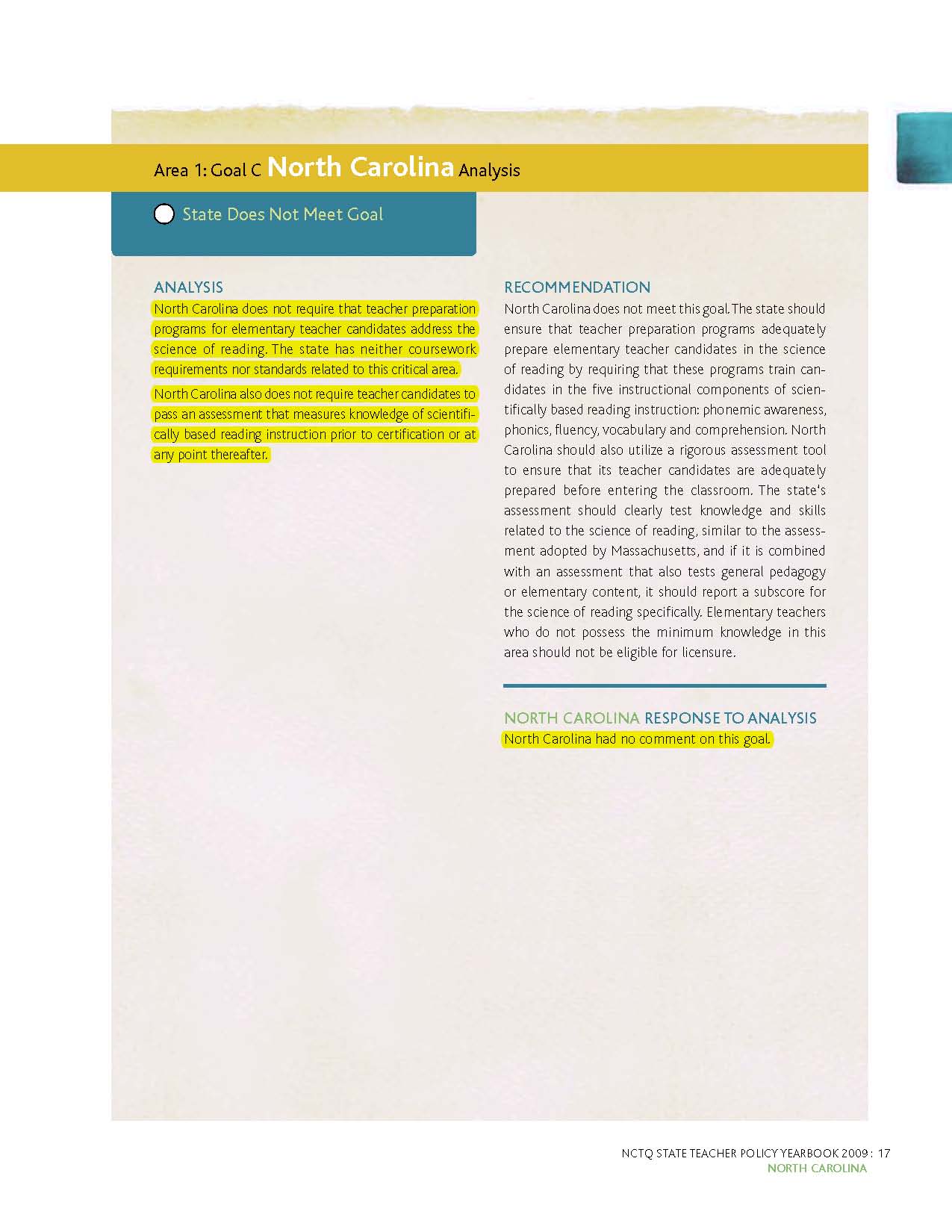
As you know, the all-powerful 8-year appointees of the SBE have wrecked our educational system and placed us 46th in the nation for high school graduation rates. Over half of our state’s low-income and minority students cannot pass the 3rd grade reading EOG. The SBE has ignored 115C-81.2 requiring research-based reading methods ever since its passage in 1996. The SBE refuses to specify meaningful certification tests for our elementary teachers thereby earning NC a “D” from the National Council of Teacher Quality (NCTQ) in their recent 152-page study of NC elementary teacher preparation.
I have consistently advocated some sort of constitutional amendment as being the only real solution to our education woes.
Best Regards,
SB 724 – Suggestions to improve an act to improve…
May 3, 2011
Re: Senate Bill 724 – An Act to Improve Public Education
Dear Senator:
Thank you for your efforts to improve education in North Carolina. Unfortunately, the addition of the new paragraph to 115C-296(b) will not accomplish anything for our children.
For well over 15 years, its sentiments have been incorporated in 115C-81.2 ‘Comprehensive plan for reading achievement”; but the State Board and the Board of Governors of the University have ignored this law completely – just as they will ignore your new paragraph and just as they have ignored the extant paragraphs directing the SBE and BGU to “evaluate and develop enhanced requirements” for continuing certification.
I would ask that you review 115C-81.2 in conjunction with the last sentence of 115C-296(a) which reads “The State Board of Education shall make any required standard initial certification exam sufficiently rigorous and raise the prescribed minimum score as necessary to ensure that each applicant has adequate academic and professional preparation to teach.”
The SBE has failed totally to specify rigorous exams for elementary teachers as the above sentence requires, in spite of the nearly $8 million annual funding in 13510-1000 to do so. The prescribed Praxis 11 and 12 exams have almost no questions that deal with learning theory, pedagogy, scientifically-based reading instruction, or classroom positive behavior management. These short rudimentary tests are primarily intended for subject matter content.
North Carolina’s preparation and testing of elementary education students as reflected by the course requirements and certification tests was evaluated by The National Council on Teacher Quality in 2009. In their 152-page report on North Carolina, they give the state’s preparation and assessment of elementary teachers a grade of “D” for reading instruction. This shoddy preparation can easily be deduced from the fact that over half of our minority and low-income students do not pass the third grade reading test nor go on to graduate high school. Our state’s overall abysmal showing on the NAEP reading tests also attests to this lack of preparation.
North Carolina should require every elementary education major to pass a comprehensive test on learning theory and instructional methods that have been scientifically validated. We should follow the example of states like Massachusetts which requires such a test of its teachers. As a result, Massachusetts ranked first in the country in 4th grade NAEP reading. One such readily available test is Pearson’s NT104 “Essential Components of Elementary Reading Instruction.”
While one may feel that such specificity should not be incorporated in law, the 300-plus pages of 115C already contain such details as the fee ($30) that must be charged a teacher to change demographic data on their certificate or to renew ($50) a certificate. If the GA finds it necessary to enshrine such matters in law, then why not protect our children from teachers who do not possess the requisite knowledge to properly teach them reading?
Please require NT104 for certification.
—————————————————————————-
$8 Million Each Year to get a Grade of “D” From the state’s budget…
Fund 13510 1000 “Establish and maintain rigorous standards for all teaching professionals in order to ensure that every student in North Carolina public schools has a knowledgeable, skilled, and compassionate teacher; and focus on standards important to the success of teachers including teacher working conditions and professional development.” $ 7,844,150
A Good Law Ignored for 15 Years§ 115C 81.2. Comprehensive plan for reading achievement.
(a) The State Board of Education shall develop a comprehensive plan to improve reading achievement in the public schools. The plan shall be fully integrated with State Board plans to improve student performance and promote local flexibility and efficiency. The plan shall be based on reading instructional practices for which there is strong evidence of effectiveness in existing empirical scientific research studies on reading development. The plan shall be developed with the active involvement of teachers, college and university educators, parents of students, and other interested parties. The plan shall, if appropriate, include revision of the standard course of study, revision of teacher certification standards, and revision of teacher education program standards.
(b) The State Board of Education shall critically evaluate and revise the standard course of study so as to provide school units with guidance in the implementation of balanced, integrated, and effective programs of reading instruction. The General Assembly believes that the first, essential step in the complex process of learning to read is the accurate pronunciation of written words and that phonics, which is the knowledge of relationships of the symbols of the written language and the sounds of the spoken language, is the most reliable approach to arriving at the accurate pronunciation of a printed word. Therefore, these programs shall include early and systematic phonics instruction. The State Board shall provide opportunities for teachers, parents, and other interested parties to participate in this evaluation and revision.
(c) In order to reflect changes to the standard course of study and to emphasize balanced, integrated, and effective programs of reading instruction that include early and systematic phonics instruction, the State Board of Education, in collaboration with the Board of Governors of The University of North Carolina and with the North Carolina Association of Independent Colleges and Universities, shall review, evaluate, and revise current teacher certification standards and teacher education programs within the institutions of higher education that provide coursework in reading instruction.
(d) Local boards of education are encouraged to review and revise existing board policies, local curricula, and programs of professional development in order to reflect changes to the standard course of study and to emphasize balanced, integrated, and effective programs of reading instruction that include early and systematic phonics instruction.
(e) Repealed by Session Laws 1997 18, s. 15(g). (1995 (Reg. Sess., 1996), c. 716, ss. 8.1, 8.2, 8.3, 8.4, 8.5(a); 1997 18, s. 15(g); 1997 456, s. 16.)
—————————————————————————
The National Council on Teacher Quality Says We Don’t Have Any
http://www.nctq.org/stpy09/reports/stpy_northcarolina.pdf
Letters to the Blogger: “Be More Civil!”
Dear Baker,
Some of your remarks are not in good taste even though they may be accurate. I am a big fan, but some of your phrasing makes me uncomfortable.
Could you please be more civil?
Comfy Conservative
Dear Comfy,
Out of curiosity, I explored the origins of the adjective “civil.” It comes from a Latin word meaning “citizen” and carried a sense of the quiet of citizens as opposed to the rudeness and militant aggressive nature of soldiers.
Going further back into the Indo-Euro roots, we find that the Latin version came from “kei-“ which originally meant “to lie down” and was associated with the comfortable couches or beds one finds when quietly passing the evening in a night’s lodging or in one’s ordinary household – as opposed to the roughhewn bunks in a military barracks or the bare ground when campaigning.
So today when someone urges us to be “civil,” he may be reverting to the oldest concept and means that we should “shut up, go home, and go to bed!“
This concept directly conflicts with the later context in which the obligation of the citizen is to participate in the political process.
Justice Clarence Thomas put everything in wonderful prospective in his famous 2001 Francis Boyer Lecture “Be Not Afraid” which may be found at www.aei.org/speech/15211
He tells of Gertrude Himmelfarb who discusses the “vigorous virtues” as opposed to the “caring virtues.” She writes in One Nation, Two Cultures, “To reduce citizenship to the modern idea of civility, the good-neighbor idea, is to belittle not only the political role of the citizen but also the virtues of the citizen – the ‘civic virtues’ as they were known in antiquity and in early republican thought.”
Justice Thomas points out “… by yielding to a false form of “civility,” we sometimes allow our critics to intimidate us. As I have said, active citizens are often subjected to truly vile attacks; they are branded as mean-spirited, racist, Uncle Tom, homophobic, sexist, etc. To this we often respond (if not succumb), so as not to be constantly fighting, by trying to be tolerant and nonjudgmental—i.e., we censor ourselves. This is not civility. It is cowardice, or well-intentioned self-deception at best.”
His speech should be read aloud in total at every annual GOP convention.
Finally, I would note philosopher and historian of science Karl Popper who correctly pointed out that the tolerant who are always civil and tolerate the intolerant eventually cease to exist.
Your discomfort may be a sign that you should reexamine your criteria.
But thank you for being a loyal fan.
YT, Baker
Review: “Home Sweet Home on the Prairie”
by Carson Robison and the Pioneers 
April 10, 2004 – With the sudden collapse of vaudeville in 1928 due to the “talkies,” many top entertainment stars were suddenly looking for new venues for their talents. At a chance NY city street corner meeting, John Mitchell, a big-time ex-vaudevillian with the Keith circuit, and Carson Robison, an established name in country songs, speculated about putting a group together to do western and folk songs. They cemented their plans and “Carson Robison and the Pioneers” were born.
John had had a vaudeville act with his brother Bill Mitchell that uniquely presented a duo of long-necked plectrum banjos playing a mixture of classical music and popular songs . Their theme song had been the energetic “Song of India” which never failed to get their audiences’ rap attention. Along with selections from Brahm’s Hungarian dances and other favorites such as “Golden Earings,” they did such roaring 20’s songs as “High-toned Mama of Mine” and “Nobody knows What a Red Hot Mama Can Do” – both Victor Record best sellers. Their act was a consistent “show-stopper” according to Variety.
Also in the Pioneers was Bill Mitchell’s wife Pearl Pickens Mitchell. Pearl was a classically trained soprano who had graduated from the Julliard School of Music before marrying Bill. Her classical training is evident in all of her recordings.
The group put their repertoire together and landed a contract to play the Victoria Palace Theater and the famous Berkeley Hotel in London in the summer of 1932. Thus began their 1932 European tour.
Londoners were quite taken with this “hill-billy” music imbued with the classical touches of the Mitchell’s. “They are four of the most popular people in London, Carson Robison is the top one, then come John and Bill Mitchell, who play banjos like angels; and then Pearl Pickens, who sings most charmingly,” wrote the London Bystander on August 19, 1932.
The Pioneers went on to play for the King and Queen and gave charity balls for the Duke and Duchess of York. Their 4-week tour lasted over a year with many European recording studios cutting their songs – from which this CD is made, and the British film studio Pathe filming a number of their performances which can be seen on the British Pathe website.
Here are the links to the Mitchell videos made in England in 1932 – 1934 with Carson.
http://www.britishpathe.com/record.php?id=9535
http://www.britishpathe.com/record.php?id=53289
http://www.britishpathe.com/record.php?id=10765
http://www.britishpathe.com/record.php?id=28029 (mis-titled as “Robinson.”)
This CD preserves the music from this pivotal introduction of folk and western music to European audiences. The Pioneers went on to return to Europe many times until the war. They also had a long-running radio show in the late thirties and forties.
Have you ever wondered, “If Roy Rogers had the ‘Sons’ of the Pioneers, who were the parents of his qroup?” Well — here are they are.
This is a great CD preserving the creative arrangements of some true musical pioneers. View their films on Pathe and, as you listen to this CD, you’ll get an appreciation of the effect they had on their audiences and how classical and country can combine.
And here is another collection from the British Academy of Country Music.

Review: “Parallel Paths to Constructivism: Jean Piaget and Lev Vygotsky” (Paperback)
by Susan Pass
August 30, 2008 – How anyone can read Vygotsky’s work and conclude that he was a constructivist is beyond me. Pass doesn’t get a pass twisting Vygotsky for her own purposes. Forget her. Read Vygotsky and Piaget for yourself and see the polar opposites.
Review: “Mind in Society: The Development of Higher Psychological Processes” (Paperback)
By L. S. Vygotsky (???Author???), Michael Cole (Editor), Vera John-Steiner (Editor), Sylvia Scribner (Editor), Ellen Souberman (Editor)
Revisionist Vygotsky – Save your money! 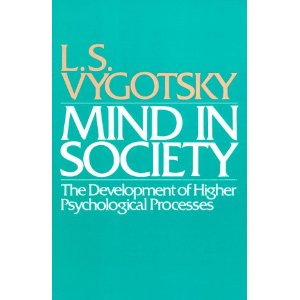
January 4, 2009 – This reissue of a 1978 reprint is supposedly a collection of Russian psychologist Vygotsky’s essays (he died in 1934) as translated from the Russian by A.R. Luria, one of his students.
The “editors” claim that after a cursory study of Luria’s translations “we came to believe that the image of Vygotsky as a sort of early neobehaviorist of cognitive development – an impression held by many of our colleagues- was strongly belied by these two works.”
Nice. A cursory study is able to strong belie widely held impressions that are based on decades of studying Vygotsky’s own 1934 book Thought and Language, among his other works. One has to wonder at the degree to which revisionism is taking place when the editors state in the preface:
“In putting separate essays together we have taken significant liberties. The reader will encounter here not a literal translation of Vygotsky but rather our edited translation of Vygotsky from which we have omitted material that seemed redundant and to which we have added material that seemed to make his points clearer.”
Hmmmm. Will the real Vygotsky please stand up!
Save your money and first get Kozulin’s version of “Thought and Language.” One must question the amount of trustworthy scholarship in “Mind in Society.”
Review: “Teaching Needy Kids in Our Backward System” (Hardcover)
by Siegfried Engelmann
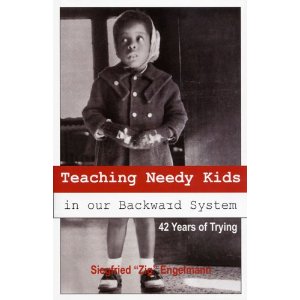
February 2, 2009: Throughout history, adventurers have chronicled their journeys though strange territories to the great benefit of mankind. Marco Polo’s journals introduced the West to the Orient. Columbus’ logs opened the western hemisphere to European exploration. Magellan, Cook, Lewis and Clark, Shackleton … their journals were invaluable to those travelers who came afterwards.
In a similar manner, Dr. Engelmann’s gripping journal of his forty-two year travel through ed land and his novel discoveries and fascinating inventions could serve us well. We may view his book as a travelogue with a wealth of “how to” information for those who may seek to follow him. He guides you successfully around the quicksand of Paiget-spawned mythology and the infamous truth-devouring bandersnatches who inhabit the dark underworlds of the treacherous territory we call our education system.
Or a second perspective of ‘Teaching Needy Kids in Our Backward System’ could be as an informal revelation for the layman of Dr. Engelmann’s theories, now scientifically proven beyond any dispute, which should occupy a place in education similar to Newton’s Principia Mathematica in physics or James Clark Maxwell’s A Dynamical Theory of the Electromagnetic Field dealing with his field equations.
Finally from a third point of view, Engelmann’s ‘Teaching Needy Kids’ could rank with Upton Sinclair’s ‘The Jungle’ which exposed the horrors of the nation’s meat packing industry and resulted in the establishment of the FDA and the closure of many food processors. It could even rank with Abraham Flexner’s ‘Report’ in 1910 that produced a national outcry to revamp the country’s medical standards causing nearly half the country’s medical schools to close.
If you want to go to the South Pole, you must read Shackleton. If you want to journey in ed land, become familiar with cutting-edge technologies, or learn about the real child abuse that undergirds the ed industry, you must read Engelmann.
Chapter 1. In Search of an Angry God
Introduction:
Anger is one of the anthropomorphic characteristics that is frequently attributed to the Biblical God. Many of us are taught the image of an angry God who often vents His wrath upon His people like some fire-breathing dragon. We may recall examples of His expelling Adam and Eve from the Garden of Eden, or when He sends the flood, or when He destroys Sodom and Gomorrah, or when He denies Moses the holy land.
Fire and brimstone! “Yep, that’s our God,” we think. The Hell and Damnation preachers like Johnathon Edwards or John Calvin have, for centuries, given us good warning of the hair-trigger temper and lightning-bolt wrath of our God.
So to get a good fix on God’s anger, let us go back and review each of these instances as reported in the Bible and see exactly how these instances are reported. These notes will use the English Standard Edition as being one of the most literal translations, but the points are well preserved in most of the other translations.
No More Garden
We all know how mad God got when he found out Adam and Eve had disobeyed him and eaten the fruit of the tree of knowledge. Let’s see how this anger is described in Genesis 3.
16 To the woman he said,
“I will surely multiply your pain in childbearing; in pain you shall bring forth children. Your desire shall be for your husband, and he shall rule over you.”
17 And to Adam he said,
“Because you have listened to the voice of your wife and have eaten of the tree of which I commanded you, ‘You shall not eat of it,’ cursed is the ground because of you; in pain you shall eat of it all the days of your life;
18 thorns and thistles it shall bring forth for you; and you shall eat the plants of the field.
19 By the sweat of your face you shall eat bread, till you return to the ground, for out of it you were taken; for you are dust, and to dust you shall return.”
20 The man called his wife’s name Eve, because she was the mother of all living.
21 And the LORD God made for Adam and for his wife garments of skins and clothed them.
22 Then the LORD God said, “Behold, the man has become like one of us in knowing good and evil. Now, lest he reach out his hand and take also of the tree of life and eat, and live forever—”
23 therefore the LORD God sent him out from the garden of Eden to work the ground from which he was taken.
Oops. Where’s the anger? Hmmmm. Nowhere does the account say that God is angry or mad at Adam and Eve. And the account explicitly states the reason that God sent them out of the garden in verse 22: God simply could no longer trust them to stay away from the forbidden tree of Life. It was because of their untrustworthiness that God was forced to make the garden off-limits. Nowhere does Genesis say that He was punishing them; rather they forced him to protect the tree of Life by keeping them away. As a result, they were out in the wild where the thorns and thistles grew, where fruits were scarce, and where they had to toil to make wheat into bread.
Like a parent who tells their youngster to stay in the shallow end of the pool and the tyke is caught paddling towards the deep end… no more playing in the cool, refreshing pool. You’ll have to play in the sandbox, instead. It isn’t anger on the part of the parent, it is love and protection of the child.
Note that verse 21 says that God even made clothes for them before he sent them out. Is this the act of an angry God or of a loving God who even regrets the necessity of his actions?
And how harsh is it out in the wild? Anthropologists studying the extant hunter-gather tribes in the Kalahari Desert or the Amazon rain forests estimate the males have about a 22-hour work week. The females spend their days in social groups gathering fruits, nuts, and berries. It was only the discovery of agriculture (more fruit from the tree of Knowledge) that resulted in the sun up to sun down sweat and toil of the early farmer.
Well, maybe God was mad; and the Bible just forgot to state it clearly. Fine. So moving on along, we next encounter Cain’s fate for murdering his brother Abel. Let us see how angry God gets at Cain.
God Deals with a Lying Murderer
Cain is jealous of Abel and murders him and then lies to God about his role in Abel’s disappearance. But in Genesis 4 God speaks.
10 And the LORD said, “What have you done? The voice of your brother’s blood is crying to me from the ground. 11And now you are cursed from the ground, which has opened its mouth to receive your brother’s blood from your hand. 12When you work the ground, it shall no longer yield to you its strength. You shall be a fugitive and a wanderer on the earth.”
Again there is no statement describing God’s anger. In fact, God is merely telling Cain that he will encounter the natural consequences of the ground’s having to receive his brother’s blood. Notice also that God is merely foretelling Cain’s future “You shall be a fugitive…” He did not say “I shall make you a fugitive…” Read carefully the next passages.
13 Cain said to the LORD, “My guilt is greater than I can bear. 14 Behold, you have driven me today away from the ground, and from your face I shall be hidden. I shall be a fugitive and a wanderer on the earth, and whoever finds me will kill me.” 15 Then the LORD said to him, “Not so! If anyone kills Cain, vengeance shall be taken on him sevenfold.” And the LORD put a mark on Cain, lest any who found him should attack him. 16Then Cain went away from the presence of the LORD and settled in the land of Nod, east of Eden.
Clearly it is Cain, who out of his own guilt, is pronouncing his own sentence of having to hide from God’s face. And God corrects him. “Not so!” In fact God marks Cain to protect him from death so that he can live out his own self-imposed sentence of life-long guilt. Cain goes on to found a city and many descendents who become herders, musicians, and metal workers.
So maybe God was not punishing Cain out of anger after all. Maybe God just let Cain punish himself. But the FLOOD… now surely that is a sign of an angry God.
World Wide Wickedness
Ok. So Maybe God wasn’t mad at Cain and let him punish himself with his guilt. But surely God worked up a mighty wrath to wipe out every living creature except Noah and his passengers. Let’s see what the Bible says in Genesis 9.
5 The LORD saw that the wickedness of man was great in the earth, and that every intention of the thoughts of his heart was only evil continually.
6 And the LORD was sorry that he had made man on the earth, and it grieved him to his heart.
7 So the LORD said, “I will blot out man whom I have created from the face of the land, man and animals and creeping things and birds of the heavens, for I am sorry that I have made them.”
8 But Noah found favor in the eyes of the LORD.
9These are the generations of Noah, Noah was a righteous man, blameless in his generation. Noah walked with God.
Wait! There’s no mention of anger here. In fact God is said to be sorrowful and that “it grieved him to his heart.” In his sorrow and grief, God is determined to “Blot out man whom I have created from the face of the earth.” But then God sees Noah and changes his mind because Noah is good and righteous.
After the flood subsides, God tells Noah and his passengers to be fruitful and multiply and even promises them that he will never do the flood thing again. An angry God? A wrathful, vengeful God? Or a sorrowful, grieving God who wants to give mankind a second chance? From the words in Genesis, it would be hard to reject the latter conclusion.
But now we come to God raining fire and brimstone upon Sodom and Gomorrah. Now here’s some professional, Jonathon-Edwards-strength anger at work!
An Outcry?
A reading of Genesis 18 seems to tell us that God was off minding His own business when He was petitioned by His people to do something about all the bad citizens in Sodom and Gomorrah.
20 Then the LORD said, “Because the outcry against Sodom and Gomorrah is great and their sin is very grave, 21 I will go down to see whether they have done altogether according to the outcry that has come to me. And if not, I will know.”
So God sends two agents to check up on Sodom and they stay with Lot. The evil townspeople try to abduct them, thereby confirming their evil ways. So God’s messengers tell Lot as follows:
12 Then the men said to Lot, “Have you anyone else here? Sons-in-law, sons, daughters, or anyone you have in the city, bring them out of the place. 13 For we are about to destroy this place, because the outcry against its people has become great before the LORD, and the LORD has sent us to destroy it.”
So twice we are told that God is only responding to an outcry of his people; which he verifies and responds with the destruction of the cities. Nowhere is it said that God is angry or mad; it is as if he is merely doing his job as a just, responsive ruler of all his people.
A Golden Calf Finally Does It… Or Not?
Let’s remember that God goes to great lengths to safeguard the Israelites’ escape from slavery by the Egyptians. He destroys the Pharaoh’s army, he feeds them manna, and safeguards them in numerous ways. And he helps Moses govern them by providing the Ten Commandments, one of which clearly proscribes any sort of idol worship.
So what do they do as soon as His back is turned; of course, they make a golden calf idol. And this is the last straw for God. As told in Exodus 32:
7And the LORD said to Moses, “Go down, for your people, whom you brought up out of the land of Egypt, have corrupted themselves. 8They have turned aside quickly out of the way that I commanded them. They have made for themselves a golden calf and have worshiped it and sacrificed to it and said, ‘These are your gods, O Israel, who brought you up out of the land of Egypt!'” 9 And the LORD said to Moses, “I have seen this people, and behold, it is a stiff-necked people. 10Now therefore let me alone, that my wrath may burn hot against them and I may consume them, in order that I may make a great nation of you.”
So now they’ve done it. And God’s wrath is finally about to manifest itself for the first time ever as he is about to turn them all into crispy critters for breaking his commandment. Or does he? Moses intervenes:
11But Moses implored the LORD his God and said, “O LORD, why does your wrath burn hot against your people, whom you have brought out of the land of Egypt with great power and with a mighty hand? 12 Why should the Egyptians say, ‘With evil intent did he bring them out, to kill them in the mountains and to consume them from the face of the earth’? Turn from your burning anger and relent from this disaster against your people. 13 Remember Abraham, Isaac, and Israel, your servants, to whom you swore by your own self, and said to them, ‘I will multiply your offspring as the stars of heaven, and all this land that I have promised I will give to your offspring, and they shall inherit it forever.'” 14 And the LORD relented from the disaster that he had spoken of bringing on his people.
So the Bible for the first time tells us God gets angry and is about to unleash for the first time his wrath, but that he is forestalled by Moses’ plea for mercy and does not consume the people by fire. .
This was a close call, and a plague is sent upon the people, but most survive. So far the only instance where we are told that God is about to act out of anger or wrath is when his chosen people ignore him as their God and worship an idol in direct violation of his first commandment.
God is obviously very upset by their idol worship. He tells them to keep going, but that he cannot stand to be around them. God implies that he would not be able to control himself if he journeyed with them and would probably burn them all up. He is, indeed, mad about this idol worship business. It really sticks in his craw, and he just needs to go away from them and cool down. But in spite of it all, God says that he will keep his promise to Abraham. As told in Exodus 33…
1The LORD said to Moses, “Depart; go up from here, you and the people whom you have brought up out of the land of Egypt, to the land of which I swore to Abraham, Isaac, and Jacob, saying, ‘To your offspring I will give it.’ 2 I will send an angel before you, and I will drive out the Canaanites, the Amorites, the Hittites, the Perizzites, the Hivites, and the Jebusites. 3 Go up to a land flowing with milk and honey, but I will not go up among you, lest I consume you on the way, for you are a stiff-necked people.”
Reviewing things to this point, we have seen disobedience, murder, and wickedness result in consequences, but none of these offenses brought about God’s anger or wrath.
But worshipping a false god finally does it.
And Then There is Leviticus
In Leviticus God lays out a number of laws and the man-enacted penalties for breaking them – stoning for a death or other offense, and an eye for an eye, a tooth for a tooth. But these are laws enforced by the people against the transgressors. And God lays them out dispassionately.
But in Leviticus 26, he tells us what his limits are.
For initial disobedience, God may send you a panic, a wasting disease, and enemies to eat your harvest. If these measures do not straighten you out, he then makes your land fallow and your trees fruitless. If you persist, he then sends wild beasts to eat your children and your livestock.
But if you still keep at it…
23″And if by this discipline you are not turned to me but walk contrary to me, 24 then I also will walk contrary to you, and I myself will strike you sevenfold for your sins.
And here he tells you he will send a pestilence and break your supply of bread.
It is not until the seventh escalation of your ignoring God that he finally gets mad:
27″But if in spite of this you will not listen to me, but walk contrary to me, 28 then I will walk contrary to you in fury, and I myself will discipline you sevenfold for your sins.
So finally after six successive warnings and punishments, God, at last, is provoked to “fury.”
But this chapter on disobedience concludes with God’s assurance of his intention of keeping his promises in spite of it all:
44Yet for all that, when they are in the land of their enemies, I will not spurn them, neither will I abhor them so as to destroy them utterly and break my covenant with them, for I am the LORD their God. 45But I will for their sake remember the covenant with their forefathers, whom I brought out of the land of Egypt in the sight of the nations, that I might be their God: I am the LORD.”
So far, we can only find idolatry and seven successive unrepentant acts that invoke God’s anger or fury.
These are rather radical acts. Recall that mere disobedience, lying, murder, and wickedness may bear consequences, but they do not necessarily invoke God’s anger. What other acts might invoke the wrath of God?
Don’t be an Ingrate
Numbers 11 brings clarity to one aspect of God’s temperament: he doesn’t like ungrateful whining complainers; they can make him very angry.
1And the people complained in the hearing of the LORD about their misfortunes, and when the LORD heard it, his anger was kindled, and the fire of the LORD burned among them and consumed some outlying parts of the camp. 2Then the people cried out to Moses, and Moses prayed to the LORD, and the fire died down. 3So the name of that place was called Taberah, because the fire of the LORD burned among them.
Apparently the people still don’t quite get it, and they complain about having to eat manna. Manna, manna, manna. They gripe about this monotonous diet and whine for some meat. This angers God and he instructs Moses to say to the people:
18… ‘Consecrate yourselves for tomorrow, and you shall eat meat, for you have wept in the hearing of the LORD, saying, “Who will give us meat to eat? For it was better for us in Egypt.” Therefore the LORD will give you meat, and you shall eat. 19 You shall not eat just one day, or two days, or five days, or ten days, or twenty days, 20 but a whole month, until it comes out at your nostrils and becomes loathsome to you, because you have rejected the LORD who is among you and have wept before him, saying, “Why did we come out of Egypt?”‘
Talk about punishment by over satiation! You want meat? I’ll give you some meat!
So, as promised, the Lord sends a wind that brings a great multitude of quail near the campsite, which the people greedily gather up and begin eating.
33 While the meat was yet between their teeth, before it was consumed, the anger of the LORD was kindled against the people, and the LORD struck down the people with a very great plague.
So we now have found three acts – idolatry, sevenfold persistent sin, and whining ungratefulness – that anger God. But leave it to Miriam and Aaron to discover how to add to this short list.
Gossip?
Numbers 12 tells about the fate of Miriam and Aaron when they gossip about God’s faithful servant Moses for having married a Cushite. God calls a meeting with the three of them in front of the tent and says:
8 “With [Moses] I speak mouth to mouth, clearly, and not in riddles, and he beholds the form of the LORD. Why then were you not afraid to speak against my servant Moses?” 9 And the anger of the LORD was kindled against them, and he departed. 10 When the cloud removed from over the tent, behold, Miriam was leprous, like snow. And Aaron turned toward Miriam, and behold, she was leprous.
After some pleading by Aaron, Moses asks God to relent. God then tells Moses to banish her out from the camp for seven days – the same punishment that a father may mete out to a disrespectful daughter. Fortunately for Miriam, Moses was kindly disposed to intercede on her behalf; but God had made his point – gossiping about his faithful servants will kindle his anger.
Cowardice and Mistrust?
As we read further in Numbers, we see that the people are near the end of their journey; they are on the threshold of the “Promised Land” – the land that flows with milk and honey. God instructs Moses to send scouts into this territory to assess the numbers and strength of the inhabitants and how their cities are fortified. After scouting for forty days, they return; and two of the scouts – Caleb and Joshua – inform the people that the inhabitants can be easily defeated. All of the other scouts, however, say that the inhabitants cannot be defeated and that the people will be slain if they try to attack. The people, fearful of defeat and ignoring God’s promise of victory, try to stone Aaron, Moses, Caleb, and Joshua and even begin to plan to return to Egypt!
God asks Moses how long will these ungrateful people continue to despise me? God tells Moses he will wipe them out with the pestilence and disinherit them.
Moses reminds God of his promise (Exodus 34) when he gave Moses the Ten Commandments:
17And now, please let the power of the Lord be great as you have promised, saying, 18 ‘The LORD is slow to anger and abounding in steadfast love, forgiving iniquity and transgression, but he will by no means clear the guilty, visiting the iniquity of the fathers on the children, to the third and the fourth generation.’ 19 Please pardon the iniquity of this people, according to the greatness of your steadfast love, just as you have forgiven this people, from Egypt until now.”
Again, God relents and while it might not be characterized as dispassionate, his response could not be characterized as anger when Gods merely foretells that although pardoned, the behavior of these men will not enable them to see the Promised Land. It can be characterized more as a natural consequence of not trusting God.
20Then the LORD said, “I have pardoned, according to your word. 21But truly, as I live, and as all the earth shall be filled with the glory of the LORD, 22 none of the men who have seen my glory and my signs that I did in Egypt and in the wilderness, and yet have put me to the test these ten times and have not obeyed my voice, 23shall see the land that I swore to give to their fathers. And none of those who despised me shall see it.
So be forewarned, ignoring God’s calling and being cowardly and mistrustful of God’s ability to deliver on His promises is not the correct behavior to exhibit when pursuing the fulfillment of these promises. Take particular note of how God makes a positive example of Caleb who is trusting and who follows God’s word:
24But my servant Caleb, because he has a different spirit and has followed me fully, I will bring into the land into which he went, and his descendants shall possess it.
As we saw in the case of disobedience, displaying mistrust and timidity result not so much in angering God, but in our own lack of spirit that is required to actualize God’s promises to us. We must be like Caleb with a different spirit and follow God fully.
So Reviewing to this Point…
Perhaps it is time to summarize what we have discovered so far in our search for an angry God.
The first point is stated in Exodus 34: God is a loving God who is slow to anger.
Secondly as he promises in Exodus, very few types of disobedience result in angering God. Most of our disobedient actions merely result in adverse consequences. There are many petty acts whereby we ignore God or refuse to acknowledge the reality of his creation – like ignoring the ice on our sidewalk which results in an injurious fall or failing to wash our hands before a meal and getting a stomach bug. These are examples of instances where we fail to respect God and His creation.
The etymology of the word “respect” is from “re” which means to “do again” as in repeat, retie, retry, and so on; and from “spec” which refers to a scene or view as in spectacle, or spectacles as eyeglasses, or spectacular, or inspect – to look closely. So “respect” has the sense of something that is worthy of a second look – something that bears closer examination.
In many cases, disobedience or disrespect causes God grief not anger, and we must suffer natural consequences. Examples are:
- the disobedience of Adam and Eve,
- the murderous jealousy of Cain,
- the wickedness that brings on the Flood
- the wickedness of Sodom and Gomorrah
- cowardice or mistrust of God’s word by the scouts
However, other acts do cause God to become angry and incite his fury. These include:
- idolatry
- seven-fold repeated disobedience after punishments
- ingratitude toward God
- gossip against God’s servants
We can now parse these two sets of behaviors and look for the common threads that run through each set.
(to be continued)
H344 – Credit Where Credit is Due!
Raleigh – The House has a solid WIN-WIN-WIN in H344. The winners are our state’s disabled children, our state’s disabled treasury, and the State Board of Education (SBE).
- The children win because their parents become eligible to receive a tax credit for getting them education help from private sources.
- The state treasury wins because the cost of the tax credit is less than the state’s cost in furnishing that help from public sources.
- The SBE wins because a part of these savings is transferred to a special education fund under its control.
This bill is that rare piece of legislation that everyone can get behind. It broadens parental choice in education for our neediest citizens – low-income children with learning disabilities – by providing up to $6,000 a year in tuition expenses. It saves the state money because the cost to serve these children in the public schools exceeds $8,100 per year per child and saves counties nearly $2,000 per year. Of the state’s savings, the bill allocates $2,000 to a separate “Fund for Special Education and Related Services” under the control of the State Board of Education. The counties save all of their portion.
The definitions of learning disabled are all based on the strict professional assessments required by the federal government under its IDEA law and regulations. A parent cannot merely claim that their child is “disabled” and receive the credit. The child must be assessed in the public school system by special education professionals and have an approved “individualized education program” – IEP. For low-income families whose state tax is less than the allowed credit, they receive reimbursement from the state for the difference.
Georgia and Florida have had similar programs in place for several years and their success is such that nearly 30 states are considering adopting some form of tax credit or “scholarship” for special needs students. Supreme Court rulings have confirmed the constitutionality of these programs.
North Carolina would be well advised to pass this law and brings these benefits to its children, its treasury, and its state board.